Last Updated on October 17, 2025 by Rajeev Bagra
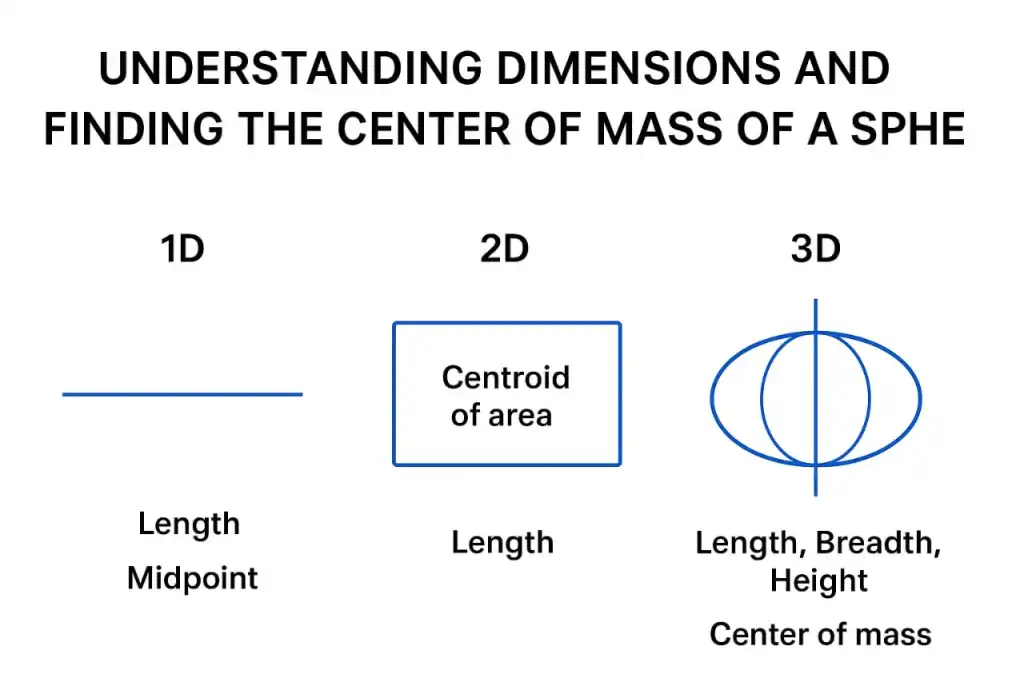
When we study geometry and physics, we often hear about one-dimensional (1D), two-dimensional (2D), and three-dimensional (3D) objects. Understanding these dimensions helps us determine how to locate an object’s center of mass — the point where its entire mass can be thought to be concentrated.
What 1D, 2D, and 3D Mean
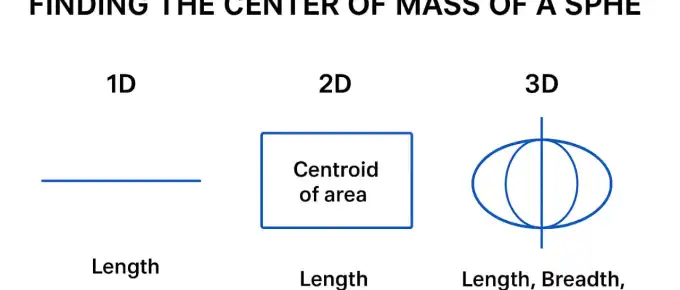
- One-Dimensional (1D):
A 1D object such as a straight line or a uniform rod has only length. Its center of mass lies at the midpoint, assuming uniform density. - Two-Dimensional (2D):
A 2D object such as a rectangle, triangle, or circle has length and breadth. It lies entirely on a plane, and we find the centroid of area instead of the center of mass. - Three-Dimensional (3D):
A 3D object such as a cuboid, sphere, or spheroid has length, breadth, and height (or depth). In this case, we find the center of mass of volume — the true spatial balance point.
A straight line is 1D, a rectangle is 2D, and a rectangular solid or spheroid is 3D. If the density is uniform, the geometric center equals the center of mass.
Center of Mass and the Disk–Shell Analogy
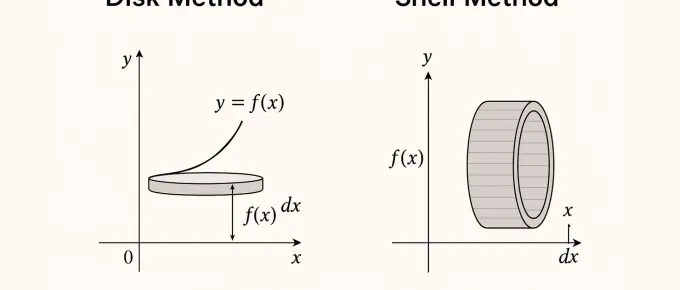
To understand the center of mass of a spheroid, we can use calculus methods similar to finding the volume of solids of revolution.
When a 2D ellipse is rotated around the x-axis, it generates a spheroid (a 3D object).
The disk method and shell method are two equivalent ways to calculate such volumes.
Disk Method: Revolve vertical slices around an axis. Each slice forms a thin disk of radius and height .
Shell Method: Revolve vertical rectangles around an axis. Each forms a cylindrical shell of radius and thickness .
In both cases, symmetry ensures that the center of mass of a uniform spheroid lies exactly at the center — along the x, y, and z axes.

Comparing Dimensions and Centers
| Object | Dimension | Quantities Involved | Center Type | Method Used |
|---|---|---|---|---|
| Line | 1D | Length | Midpoint | Average of endpoints |
| Rectangle | 2D | Length & Breadth | Centroid of area | Integration over area |
| Spheroid | 3D | Length, Breadth, Height | Center of mass | Disk or shell method |
Visual Representation
Below is a simple visual comparison showing how dimensions evolve:
- A straight line → 1D → midpoint as center of mass.
- A flat rectangle → 2D → centroid of area.
- A rotated ellipse (spheroid) → 3D → center of mass of volume.