Last Updated on July 4, 2025 by Rajeev Bagra
Bisection search: Reason for subtracting 1 in case of high and adding 1 in case of low with firstnum
byu/DigitalSplendid inlearnpython
Bisection search — is one of the most efficient ways to find a value in a sorted list or range. It’s a classic divide-and-conquer algorithm that cuts the search space in half each time, giving it a powerful time complexity of O(log n).
But there’s a subtle trap many beginners fall into:
Not excluding the midpoint (
mid) from the next search interval.
In this post, we’ll explore why it’s critical to adjust the bounds properly using +1 and -1, and what can go wrong if you don’t — including infinite loops, stuck iterations, and never terminating when the target isn’t found.
The Structure of Bisection Search
Here’s how a correct bisection search typically works:
low = 0 high = len(arr) - 1 while low <= high: mid = (low + high) // 2 if arr[mid] == target: return mid elif arr[mid] > target: high = mid - 1 # ⬅ eliminate mid else: low = mid + 1 # ⬅ eliminate midThe mid - 1 and mid + 1 parts are essential. They exclude the current mid value from the next search range, because we’ve already checked it.
What Happens If You Don’t Use +1 or -1?
Let’s say you do this instead:
if arr[mid] > target: high = mid # wrong else: low = mid # wrongYou haven’t excluded mid. That might seem harmless — but in practice, it breaks the whole algorithm.
Example 1: Target Not Present — Infinite Loop
Let’s search for target = 99.5 in a list of integers from 0 to 100. This number doesn’t exist in the list.
low = 0 high = 100 while low <= high: mid = (low + high) // 2 if mid > 99.5: high = mid # wrong else: low = mid # wrongStep-by-step:
- mid = 50 → too low → low = 50
- mid = 75 → too low → low = 75
- …
- mid = 99 → too low → low = 99
- mid = 99 → too low → low = 99
- mid = 99 → again!
You’re stuck infinitely checking mid = 99.
You’ve stopped shrinking the search space — that’s the problem!
Example 2: Target Is Present — Still Stuck
Now let’s say the target is 99 (which is in the list), but you still don’t use +1 or -1.
if mid > target: high = mid # else: low = mid # Eventually you’ll get:
- mid = 99 → matches target → great!
- But if you mistakenly check
arr[mid] != target, or need more precision (e.g., float comparison), you could: - loop forever
- never reach the exact value
Without +1 and -1, you may keep checking the same value again and again, and never converge.
The Fix: Always Exclude mid
To prevent this, the correct binary search approach must adjust the bounds like this:
if mid > target: high = mid - 1 # Exclude mid elif mid < target: low = mid + 1 # Exclude mid else: return mid # Found itEach iteration now guarantees that the search range shrinks. Eventually, either:
- You find the target, or
low > high, and you exit the loop correctly.
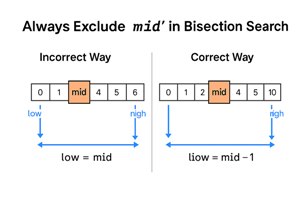
Visual Summary
| Incorrect Way | Correct Way |
|---|---|
high = mid | high = mid - 1 |
low = mid | low = mid + 1 |
| Might recheck same value | Always excludes mid |
| Can get stuck forever | Always progresses |
Pro Tip: Bisection Search is Precise, But Sensitive
Bisection search is powerful, but it’s also sensitive to off-by-one errors. Always make sure you:
- Exclude the
midafter using it. - Use
// 2for integer division in Python. - Handle edge cases where the target doesn’t exist.
Final Thoughts
The devil is in the details. Bisection search isn’t just about halving the list — it’s about doing it right.
Next time your bisection search is stuck in an infinite loop or not returning results, remember:
Did I exclude the midpoint properly using
+1or-1?
That one line could be the difference between an elegant solution and a frustrating bug.