Last Updated on October 18, 2025 by Rajeev Bagra
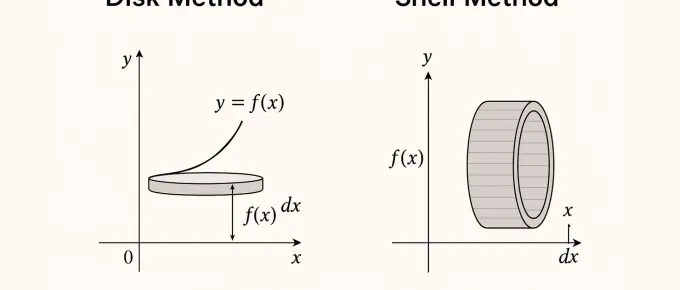
In calculus, it’s fascinating that the disk and shell methods both yield the same volume for a solid of revolution. Yet in practice, one can make your work smooth and elegant—while the other can make it messy.
Take the witches’ kettle example. The temperature inside the kettle isn’t uniform—it varies with height, from 100°C at the bottom to 70°C at the top. The goal is to find the total heat required to raise water from 0°C to this temperature distribution.
Now, the key step isn’t jumping straight into integration—it’s how you slice the problem.
If you think vertically, temperature keeps changing along the slice.
But if you slice horizontally, each thin layer has a constant temperature.
This means the temperature at height y can be described by:

This transforms a complex three-dimensional situation into something much simpler—a stack of thin, uniform disks. Each disk has a fixed temperature, and when we rotate around the y-axis, the total heat can be found by integrating with respect to dy.
Even though the disk and shell methods can describe the same solid, one method often aligns better with the nature of variation in the problem—here, temperature changing with height.
The moral:
Before diving into formulas, pause to think about what varies, and along which direction.
A few moments of setup can save hours of algebra. The best mathematicians and scientists don’t just compute—they choose their approach wisely.