Last Updated on October 10, 2025 by Rajeev Bagra
When a 2-D region is revolved around an axis, it creates a 3-D solid. To find the volume of such a solid, we slice it into many thin pieces, find the volume of each slice, and then integrate (add up) all slices.
There are two main techniques for this in definite integral calculus: the Disk/Washer Method and the Shell Method.
Intuitive Understanding
Disk (or Washer) Method
- Slices are made perpendicular to the axis of revolution.
- Each slice forms a disk (or washer if there’s a hole).
- The volume is the sum (integral) of these disk volumes.
Think of stacking thin coins or CDs along an axis.
Shell Method
- Slices are made parallel to the axis of revolution.
- Each slice forms a thin cylindrical shell when revolved.
- The total volume is obtained by adding up all these shell volumes.
Think of many paper tubes (cylindrical shells) wrapped around the axis.
Mathematical Formulas
Disk Method (No Hole)
For a region bounded by ( y = f(x) ), revolved about the x-axis:
![;V = \pi \int_a^b [f(x)]^2 , dx;](https://img.gamelinxhub.com/images/latex.php?latex=%3BV+%3D+%5Cpi+%5Cint_a%5Eb+%5Bf%28x%29%5D%5E2+%2C+dx%3B&bg=ffffff&fg=000&s=0&c=20201002)
Washer Method (With Inner and Outer Radii)
For a region between ( y = R(x) ) and ( y = r(x) ) revolved about the x-axis:
![;V = \pi \int_a^b \left( [R(x)]^2 - [r(x)]^2 \right) dx;](https://img.gamelinxhub.com/images/latex.php?latex=%3BV+%3D+%5Cpi+%5Cint_a%5Eb+%5Cleft%28+%5BR%28x%29%5D%5E2+-+%5Br%28x%29%5D%5E2+%5Cright%29+dx%3B&bg=ffffff&fg=000&s=0&c=20201002)
Shell Method (Around the y-axis)
For a region under ( y = f(x) ) from ( x=a ) to ( x=b ):

Shell Method (Around the x-axis)
If the region is described by ( x = f(y) ) from ( y=c ) to ( y=d ):

Conceptual Diagrams
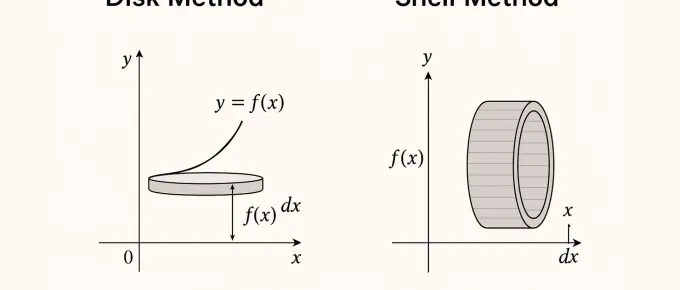
Disk / Washer Method
y ↑ ***** * * y = f(x) * * * * ***** +------------------> x Thin slices (disks) perpendicular to x-axis Here’s the same text rewritten with proper LaTeX shortcodes so it renders correctly:
Each slice has a radius 
![;\pi [f(x)]^2;](https://img.gamelinxhub.com/images/latex.php?latex=%3B%5Cpi+%5Bf%28x%29%5D%5E2%3B&bg=ffffff&fg=000&s=0&c=20201002)
Volume of slice ≈ ![;\pi [f(x)]^2 , dx;](https://img.gamelinxhub.com/images/latex.php?latex=%3B%5Cpi+%5Bf%28x%29%5D%5E2+%2C+dx%3B&bg=ffffff&fg=000&s=0&c=20201002)
Shell Method
y ↑ ______ ← vertical strip at x; when revolved, forms a thin shell +------------------> x x x+dx When this strip at (x) (height (f(x))) revolves around the y-axis:
- Circumference = (2.pi.x)
- Height = (f(x))
- Thickness = (dx)

Worked Examples
Example 1 — Disk Method
Find the volume formed by revolving the region under ( y = x^2 ) from ( x = 0 ) to ( x = 1 ) about the x-axis.
The volume using the disk method is:

Evaluating the integral:
![;V = \pi \left[ \frac{x^5}{5} \right]_0^1 = \frac{\pi}{5};](https://img.gamelinxhub.com/images/latex.php?latex=%3BV+%3D+%5Cpi+%5Cleft%5B+%5Cfrac%7Bx%5E5%7D%7B5%7D+%5Cright%5D_0%5E1+%3D+%5Cfrac%7B%5Cpi%7D%7B5%7D%3B&bg=ffffff&fg=000&s=0&c=20201002)
Hence, the volume of the solid formed by revolving ( y = x^2 ) about the x-axis is π/5 cubic units.
Example 2 — Shell Method
Revolve the same region ( y = x^2 ), ( 0 \le x \le 1 ), around the y-axis.
The volume using the shell method is:

Evaluating the integral:
![;V = 2\pi \left[ \frac{x^4}{4} \right]_0^1 = \frac{\pi}{2};](https://img.gamelinxhub.com/images/latex.php?latex=%3BV+%3D+2%5Cpi+%5Cleft%5B+%5Cfrac%7Bx%5E4%7D%7B4%7D+%5Cright%5D_0%5E1+%3D+%5Cfrac%7B%5Cpi%7D%7B2%7D%3B&bg=ffffff&fg=000&s=0&c=20201002)
Hence, the volume of the solid formed by revolving ( y = x^2 ) about the y-axis is π/2 cubic units.
Example 3 — Choosing Between Disk and Shell
For the region bounded by 


- Disk method (simple):

Shell method (harder):
Would require expressing ( x ) as a function of ( y ) and integrating with respect to ( y ).
Hence, Disk/Washer method is the better choice here.
When to Use Which
| Situation | Use Disk/Washer | Use Shell |
|---|---|---|
| Axis of rotation is x-axis and function is (y=f(x)) | ||
| Axis of rotation is y-axis and function is (y=f(x)) | ||
| Easy to express radius | ||
| Easy to express height × radius | ||
| Cross-sections perpendicular to axis | ||
| Cross-sections parallel to axis |
Summary of Key Formulas
| Method | Formula | Axis |
|---|---|---|
| Disk | ![;V=\pi\int_a^b [f(x)]^2 dx;](https://img.gamelinxhub.com/images/latex.php?latex=%3BV%3D%5Cpi%5Cint_a%5Eb+%5Bf%28x%29%5D%5E2+dx%3B&bg=ffffff&fg=000&s=0&c=20201002) | x-axis |
| Washer | ![;V=\pi\int_a^b ([R(x)]^2 - [r(x)]^2) dx;](https://img.gamelinxhub.com/images/latex.php?latex=%3BV%3D%5Cpi%5Cint_a%5Eb+%28%5BR%28x%29%5D%5E2+-+%5Br%28x%29%5D%5E2%29+dx%3B&bg=ffffff&fg=000&s=0&c=20201002) | x-axis |
| Shell |  | y-axis |
| Shell |  | x-axis |
Final Thoughts
- Disk/Washer → use when perpendicular slicing gives easy radii.
- Shell → use when parallel slicing gives easier height × radius.
- If one looks messy, try the other — both represent the same geometric idea: summing infinitely thin volumes to find total volume.