Last Updated on September 24, 2025 by Rajeev Bagra
An ordinary differential equation (ODE) relates a function y(x) to its derivatives. For example:

This equation says the slope of the function y(x) at every point equals the x-coordinate.
What does a “solution” mean?
A solution is a function y(x) whose derivative satisfies the ODE everywhere. For our example we integrate to find the general solution:

Here C is an arbitrary constant. If you give an initial condition (for example y(0)=1), you get a particular solution. Example:


Slope fields (intuition)
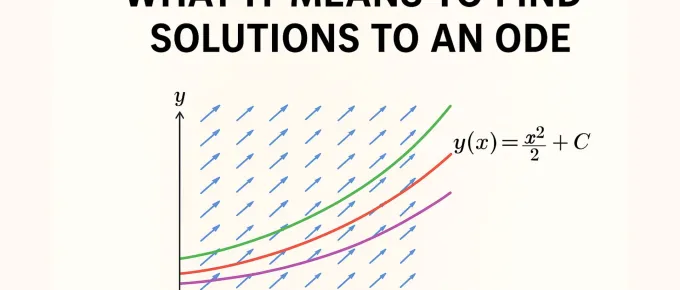
A slope field draws a small line segment at each point (x,y) with slope given by the right-hand side of the ODE. For dy/dx = x the slopes depend only on x: horizontal at x=0, slanted up at x>0, slanted down at x<0. The solution curves (the parabolas above) fit into that field.
General vs particular solutions
- General solution: family of solutions with constants still free (e.g.,
y= x^2/2 + C). - Particular solution: specific function after applying an initial condition (e.g.,
y(0)=1givesy=x^2/2+1).
Takeaway: finding solutions to an ODE means finding the function(s) whose derivatives follow the rule the ODE gives — the ODE tells you the slope everywhere, and the solution is the curve that has those slopes.