Last Updated on October 19, 2025 by Rajeev Bagra
When learning Python and exploring object-oriented programming (OOP), beginners often encounter something that looks like a function but behaves differently:
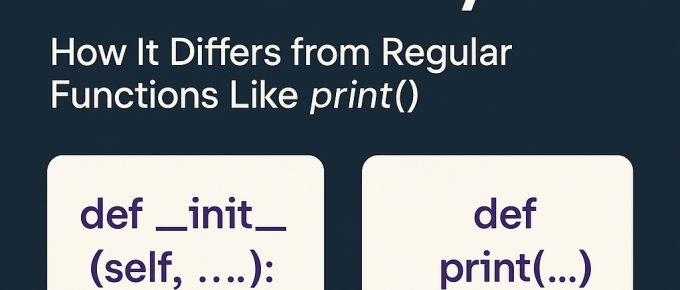
def __init__(self, ...): At first glance, it seems like we’re just defining a function inside a class. But what’s really going on? Why doesn’t this behave like a regular function like print() or len()? Let’s break it down.
Is __init__ a Function?
Yes — __init__ is a function, but it’s a special kind of function in Python known as a dunder method (short for “double underscore”).
More specifically, __init__ is a constructor. It’s automatically called when a new object is created from a class. You can think of it as a setup function that runs only once when you create an object.
Example: Defining a Class With __init__
class Person: def __init__(self, name, age): print("Initializing a new Person object...") self.name = name self.age = age Now when you create a new Person object:
p1 = Person("Alice", 30) This automatically triggers:
__init__(self=p1, name="Alice", age=30) Which sets:
p1.name = "Alice" p1.age = 30 How __init__ Differs From Regular Functions
Let’s compare it to a built-in function like print():
| Feature | print() | __init__() |
|---|---|---|
| Where it lives | Globally available | Inside a class |
| When it’s called | When you type print(...) | Automatically, when you create an object |
| Purpose | Display information | Initialize object data |
| Defined by | Python’s standard library | You (in your class definition) |
Each Class Has Its Own __init__
Unlike built-in functions which are defined once and reused globally, each class in Python defines its own version of __init__, tailored to what that class represents.
Example: Two Different __init__ Methods
class Dog: def __init__(self, breed): self.breed = breed class Car: def __init__(self, brand, year): self.brand = brand self.year = year Usage:
d = Dog("Labrador") c = Car("Toyota", 2020) print(d.breed) # Labrador print(c.brand) # Toyota print(c.year) # 2020 The Dog class and Car class both have their own custom initialization logic, defined by their own __init__ methods.
Summary
| Concept | Meaning |
|---|---|
__init__ | Special method to initialize a new object |
| Defined per class | Yes, each class has its own __init__ |
| Called automatically | Yes, when you create an object like obj = Class() |
| Purpose | Set up the initial state of the object |
Difference from print() | print() is global and reused; __init__ is class-specific |
Final Thoughts
The __init__ method may look like just another function, but it plays a key role in Python’s object-oriented design. Think of it as the birth script for every object — customizing how it starts its life. And unlike regular functions like print() or input(), __init__ is yours to define inside each class, making it incredibly flexible and powerful.
Want to practice? Try creating your own class with __init__ and explore how object data is stored and accessed. It’s one of the most fundamental skills in Python programming!