Last Updated on August 2, 2025 by Rajeev Bagra
When working with binary trees in Python, comparing two trees for equality is a common task—whether for testing, validation, or logic flow. You might expect that comparing trees is simple, but the magic lies in how Python uses recursion and short-circuit logic to perform this task efficiently.
In this post, we’ll uncover how a binary tree class uses the special __eq__ method to recursively compare itself with another tree—left first, then right.
The __eq__ Method in Python
In Python, when you use the == operator between two objects, it internally calls the __eq__ method defined in the class of those objects.
Here’s how it might look in a custom binary tree Node class:
class Node: def __init__(self, value, left_child=None, right_child=None): self.value = value self.left = left_child self.right = right_child def __eq__(self, tree): return (self.value == tree.value and self.left == tree.left and self.right == tree.right) This method compares:
- The value of the current nodes,
- The left child nodes (recursively),
- The right child nodes (recursively).
How the Recursion Works
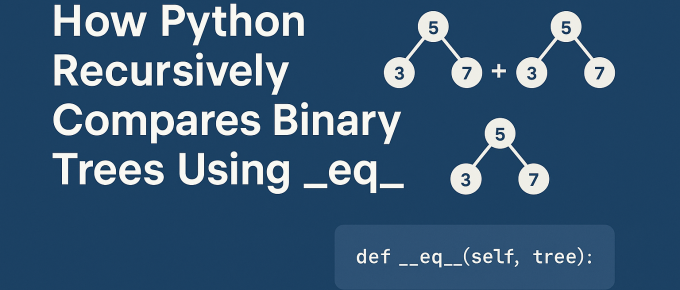
Let’s say you have two trees like this:
a = Node(5, Node(3), Node(7)) b = Node(5, Node(3), Node(7)) print(a == b) # True Step-by-Step Evaluation:
- Compare root values:
5 == 5 - Recursively compare left subtrees:
Node(3) == Node(3)3 == 3- Left and right are both
None
- Recursively compare right subtrees:
Node(7) == Node(7)7 == 7- Left and right are both
None
Result: The trees are identical.
Left First, Then Right — Not Simultaneous
Python uses short-circuit logic with the and operator. This means:
return (self.value == tree.value and self.left == tree.left and self.right == tree.right) Evaluates in this order:
self.value == tree.valueself.left == tree.left(recursive call)self.right == tree.right(recursive call)
Python stops evaluating as soon as any condition fails.
For example:
a = Node(5, Node(3), Node(7)) b = Node(5, Node(4), Node(7)) print(a == b) # False Here, Node(3) != Node(4), so Python never even compares the right child.
Visual Diagram of Comparison
Compare: [5] == [5] ------------------------- [3] == [3] [7] == [7] [None]==[None] [None]==[None] [None]==[None] [None]==[None] Summary
- The
__eq__method recursively checks whether two binary trees are equal. - Python evaluates conditions left to right, with left subtree checked first.
- The use of
andensures short-circuiting—it skips unnecessary comparisons. - This is a depth-first approach to tree equality.
Practice Challenge
Try writing your own tree comparison method without using ==, and test whether you understand the flow. Use small trees, draw them on paper, and trace the recursion manually. You’ll gain powerful insight into both recursion and Python’s evaluation model.