Last Updated on May 18, 2025 by Rajeev Bagra
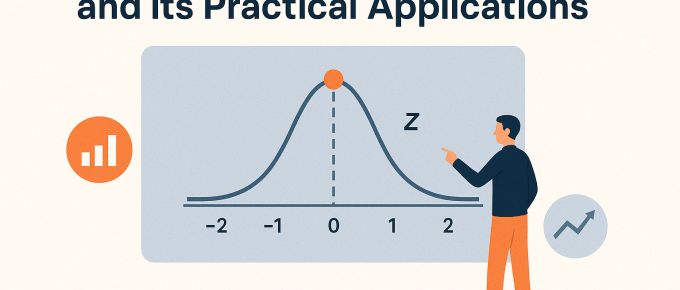
In statistics, a z-score is a standardized score that indicates how many standard deviations a particular value is from the mean of its dataset. Also called a standardized score, the z-score allows for comparing values across different datasets by converting them to a common scale. This article explores the concept of z-scores, their calculation, and their practical applications, especially in fields like stock market analysis, academic testing, quality control, and health sciences.
What is a Z-Score?
A z-score measures how far a value deviates from the mean of its dataset, expressed in terms of standard deviations. A z-score:
- Above 0 indicates the value is above the mean.
- Below 0 indicates the value is below the mean.
- Equal to 0 shows the value matches the mean.
The formula to calculate a z-score for a value X in a dataset with mean 

z =

Using this formula, a dataset’s values can be converted into standardized scores, where the mean is 0 and the standard deviation is 1. This transformation is useful for comparing scores across datasets with different means and standard deviations.
How Z-Scores Help Compare Across Different Distributions
When datasets have different means or levels of variability, z-scores standardize them, making comparisons straightforward. For example, suppose two datasets represent student scores from two different exams, each with a distinct mean and standard deviation. By converting each score to a z-score, we put them on a shared scale, allowing us to:
- Compare individual performances across exams.
- Identify which students performed better relative to their peers, even if the exams had different difficulty levels.
Let’s demonstrate with an example.
Example: Standardizing Exam Scores
Imagine two students:
- Student A scores 85 on Exam 1 (mean = 75, standard deviation = 5).
- Student B scores 90 on Exam 2 (mean = 80, standard deviation = 8).
Calculating their z-scores:
- Student A’s z-score:
- Student B’s z-score:


Although Student B scored higher in raw terms (90 vs. 85), Student A performed better relative to the class by being 2 standard deviations above the mean compared to Student B’s 1.25. Thus, z-scores reveal a more meaningful comparison.
Practical Applications of Z-Scores
Z-scores have various applications across disciplines. Here are some of the most practical uses:
1. Academic Testing and Grading
- Application: Standardized tests (e.g., SAT, GRE) use z-scores to compare results across different test versions.
- Benefit: Z-scores allow scores to be compared fairly across years or test versions, determining relative student performance.
2. Quality Control in Manufacturing
- Application: Manufacturers use z-scores to monitor production quality. Measurements that deviate significantly from the target range indicate potential issues.
- Benefit: Z-scores help maintain product consistency by flagging outliers and identifying defects early.
3. Financial Market Analysis
- Application: Z-scores assess relative stock performance by showing how much a stock’s return deviates from the market average.
- Benefit: Investors can identify unusually high or low returns, helping in risk assessment and investment decisions.
Let’s explore a detailed example of z-scores in stock market analysis.
Z-Scores in Stock Market Analysis: Comparing Stocks Across Different Markets
Comparing stocks across different stock markets (like the S&P 500 and FTSE 100) is challenging due to varying average returns and volatilities. Z-scores standardize stock returns, allowing direct comparisons even between markets with different characteristics.
Example Scenario
Suppose we have two stocks from two different markets:
- Stock X in Market A:
- Return: 6%
- Market A Average Return: 4%
- Market A Standard Deviation: 1.5%
- Stock Y in Market B:
- Return: 7%
- Market B Average Return: 5%
- Market B Standard Deviation: 2%
Step 1: Calculate Z-Scores for Each Stock
For Stock X in Market A:

For Stock Y in Market B:

Step 2: Interpret the Z-Scores
- Stock X (z = 1.33) is performing 1.33 standard deviations above the market average, which is better than Stock Y’s performance relative to its market.
- Stock Y (z = 1.0) is only one standard deviation above its market average.
Thus, despite a higher raw return, Stock Y’s performance is relatively weaker when standardized. This standardization is invaluable in determining which stocks have stronger relative performances across different markets.
Other Real-World Applications of Z-Scores
- Health and Medical Statistics: Z-scores standardize health indicators (e.g., BMI, blood pressure) against population norms, aiding in identifying conditions like malnutrition or hypertension.
- Psychology and Behavioral Sciences: Z-scores in IQ tests or personality assessments provide a standardized view of a person’s traits relative to the population.
- Business Performance Metrics: Companies compare employee performance metrics (like sales figures) across departments using z-scores to account for different baseline performances.
Key Benefits of Using Z-Scores
- Standardization for Fair Comparison: Z-scores normalize different datasets, allowing for fair comparisons.
- Identification of Outliers: Z-scores reveal values that deviate significantly from the average, highlighting potential areas of interest or concern.
- Universality Across Fields: Z-scores apply broadly, from education to finance, health, and more.
Conclusion
Z-scores are a powerful tool in data analysis, transforming raw scores into standardized units that enable meaningful comparisons. By understanding z-scores, we gain insights into how values relate to their dataset averages and can fairly compare different distributions, even across different fields and markets. This makes z-scores essential in fields that require objective comparisons and assessments based on relative performance.
Disclaimer: This article was generated with the assistance of large language models. While I (the author) provided the direction and topic, these AI tools helped with research, content creation, and phrasing.